
Series Context: Failure Patterns in Salesforce to QuickBooks Sync
**Written by Dorian Sabitov and Antonina Kharchenko
Salesforce and QuickBooks integration rarely happens as a completely new, all-in-one project. For the most part, it is implemented gradually, driven by the need to “just send invoices,” and then expands over time as billing, reporting, and operational needs grow.
This is why we end up with synchronization that works technically but, in practice, is unpredictable, especially under real-world conditions with factors like higher volume, corrections, retries, and audits.
It’s no secret that QuickBooks is not a niche accounting system. With more than 62% market share in U.S. small-business accounting software, it sits at the center of financial operations for millions of organizations. This means the likelihood that an organization uses both Salesforce and QuickBooks is quite high.
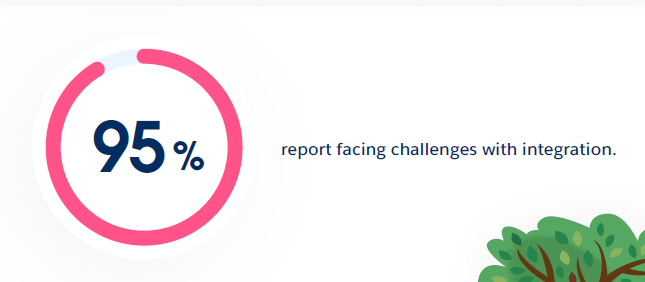
At the same time, software integrations are always a challenge, as confirmed by the 2025 MuleSoft Connectivity Benchmark, which found that 95% of IT leaders surveyed reported ongoing challenges integrating data across systems.
For that reason, this series of posts examines five points of failure that can be fixed and strengthened:
- Auth, environment, and endpoint mismatches
- Customer matching failures and duplicate creation
- Product, pricing, and line-item semantics drift
- Failures in partial data syncs
- Sync jobs failing under real-world conditions
Organizations typically approach Salesforce to QuickBooks sync in one of three ways: building custom integrations directly against the QuickBooks API, using an iPaaS platform such as MuleSoft to orchestrate data flows, or installing a native AppExchange connector. Each model differs in where logic, mapping, and monitoring reside. While different approaches provide varying levels of built-in safeguards, certain sync failure patterns remain common across approaches.
In this first article, we focus on the most deceptively simple category: authentication and environment mismatches.
Antonina Kharchenko is a Salesforce Admin with six certifications and a 2-Star Ranger on Trailhead. She works with Salesforce systems, automation, and process improvement, and enjoys turning her day-to-day experience into useful articles.
Dorian Sabitov is a 4x Certified Salesforce Administrator and Developer with extensive experience in customizing Salesforce to the client’s needs. He started his journey in IT as a CRM admin and kept his focus on the Salesforce ecosystem. He loves exploring new integrations in Salesforce and spotting alternative ways to optimize business processes inside the CRM. He is currently working as a full-time Salesforce developer and contributing content to the SFApps.info educational portal.

